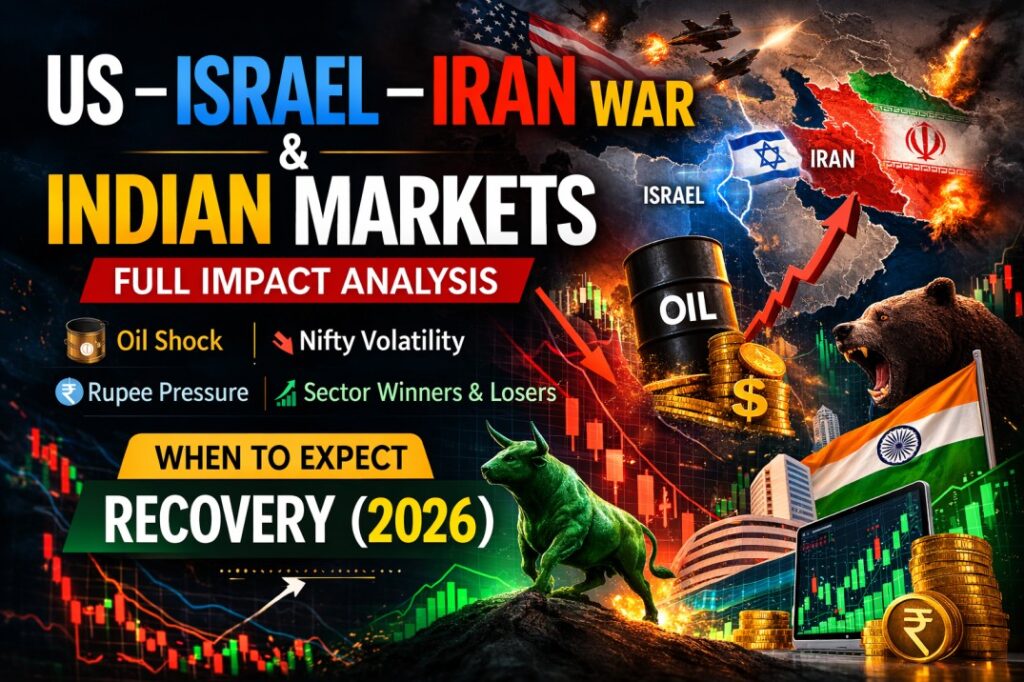
US–Israel–Iran War & Indian Markets: Full Impact Analysis & When to Expect Recovery (2026)
Introduction: When Wars Hit Your Portfolio The ongoing military escalation involving the United States, Israel, and Iran has shaken global financial markets, and India is feeling the tremors all the way on Dalal Street. If you have been watching your Sensex or Nifty portfolio dip in recent weeks, you are not imagining it. Geopolitical storms in the Middle East have a very direct and measurable impact on India’s economy, and 2026 is proving to be no exception.In this detailed blog, we break down exactly how this conflict is affecting Indian markets, which sectors are hurting most, which ones are quietly gaining, what the rupee and inflation picture looks like, and most importantly, when investors can realistically expect a recovery. 📌 KEY STAT: Over ₹11 lakh crore was wiped from Indian market capitalisation in the immediate aftermath of the US–Israel strikes on Iran. The Sensex fell more than 1,000 points in a single session. Why Does a Middle East War Affect Indian Markets? A. Crude Oil — India’s Biggest Vulnerability India imports approximately 88–89% of its crude oil requirements, spending around $137 billion annually on crude oil imports, nearly 15% of the country’s total import bill. Any disruption in the Middle East, which controls a major share of global oil supply, immediately raises the cost of energy for India. The Strait of Hormuz, a narrow waterway through which roughly 30% of the world’s seaborne oil passes, runs through the conflict zone. Fears of its closure have already pushed Brent crude up by 9–10%, from around $70 to nearly $80 per barrel. If a blockade materialises, analysts warn that oil could surge to $120 per barrel. 💡 Did You Know: Every $10 rise in crude oil prices slows India’s GDP growth by 0.3–0.4% and pushes Consumer Price Inflation (CPI) up by approximately 0.4%. B. Foreign Portfolio Investor (FPI) Sell-Off Foreign Portfolio Investors own nearly 20% of Indian equities. During periods of global geopolitical tension, these investors instinctively move toward safe-haven assets — US Treasury bonds, gold, and the US dollar, pulling money out of emerging markets like India. This FPI outflow creates selling pressure on Indian stocks and weakens the rupee simultaneously. C. Global Risk Sentiment & Supply Chain Disruptions Beyond oil, the conflict disrupts shipping routes across the Gulf and West Asia. Indian exporters, especially in pharmaceuticals, chemicals, and engineering goods, face higher freight costs, insurance premiums, and order delays. This squeezes corporate margins and weighs on broader market sentiment. 2. How Has the Indian Market Reacted So Far? Indian benchmark indices have witnessed significant selling pressure since tensions escalated: Markets have reacted not just to the actual conflict but to the fear of prolonged disruption. Investor sentiment is extremely sensitive to geopolitical headlines, and this uncertainty creates volatility beyond what the underlying economic impact alone would justify. 3. Sector-by-Sector Impact on Indian Markets 🔴 Sectors Under Pressure Aviation & Travel: Airlines are among the hardest hit. Aviation Turbine Fuel (ATF) is a crude oil derivative, and with fuel costs rising sharply, airline margins are being severely compressed. Aviation stocks have seen declines of 8–10%. Hotel companies have also reported booking cancellations due to flight disruptions. Oil Marketing Companies (OMCs): OMCs such as HPCL, BPCL, and IOC face a classic squeeze; they buy crude at global prices but often cannot pass the full increase to consumers immediately due to price regulation. This creates margin compression and negative investor sentiment. Auto & Tyre Manufacturers: Higher crude oil means higher input costs for rubber and petrochemical derivatives used in tyres. Export-heavy auto players also face rising shipping costs. Domestic auto volumes remain healthy, which limits downside, but near-term margin pressure is real. Chemicals & Pharmaceuticals: Rising Gulf shipping costs are pushing up raw material prices and logistics costs. West Asia and North Africa represent about 5.7% of India’s pharmaceutical exports (approximately $1.75 billion in FY25), creating near-term challenges. Engineering & EPC Companies: Firms with significant order books from Gulf countries, Saudi Arabia, UAE, and Kuwait face risks of project delays if the regional situation deteriorates further. Consumer Staples & FMCG: Higher input costs tied to crude oil and weakening consumer sentiment create headwinds for FMCG companies, though the impact is more gradual. 🟢 Sectors Likely to Benefit Defence: Stocks like HAL (Hindustan Aeronautics Limited) and Bharat Electronics Limited (BEL) have historically rallied during geopolitical tensions. During the April 2024 Iran–Israel escalation, HAL’s stock rose 12%. Long-term, the conflict supports India’s domestic defence manufacturing push. Gold & Silver: Safe-haven demand for precious metals spikes during geopolitical uncertainty. Gold prices have already risen about 3%, and MCX benefits from higher trading volumes in bullion and energy. Upstream Oil Producers: Domestic oil exploration companies benefit from higher global crude prices as their asset realisation increases. IT Sector (Mixed): A stronger US dollar during global risk-off periods benefits Indian IT exporters in rupee terms. However, if global growth concerns mount, order inflows could slow, making this a mixed picture overall. 4. Impact on the Indian Rupee and Inflation The rupee has come under meaningful pressure. A combination of FPI outflows, rising import bills (especially crude), and a global flight to the US dollar has pushed the currency weaker. A weaker rupee is inflationary by nature; it makes every import more expensive, including crude oil, edible oils, electronics, and capital goods. If crude prices stay elevated for an extended period, the Reserve Bank of India (RBI) may face pressure to keep interest rates higher for longer, which would weigh on rate-sensitive sectors, including banking, real estate, and consumer finance. ⚠️ Macro Risk: If oil prices sustain above $100/barrel, India’s current account deficit could widen significantly, GDP growth could slow by 0.4–0.5%, and CPI inflation could re-accelerate forcing RBI to delay its rate-cutting cycle. 5. Historical Precedents: What Past Crises Tell Us India’s markets have weathered multiple geopolitical shocks before. History offers a reassuring roadmap: The consistent pattern across these crises: sharp initial panic, heightened volatility for weeks, followed by stabilisation once geopolitical clarity emerges. 6. When Can