Introduction
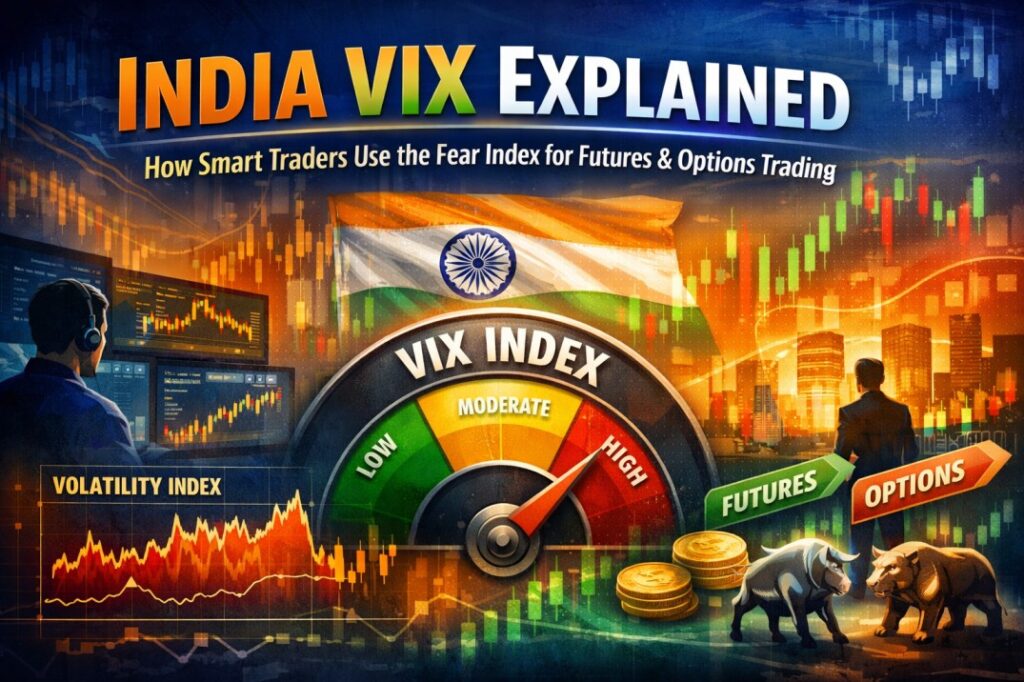
In the Indian stock market, traders constantly look for clues about future volatility and market sentiment. One of the most powerful indicators for this purpose is India VIX, often called the Fear Index of the Indian markets.
Whether you trade Nifty Futures, Options, intraday strategies, or positional setups, understanding India VIX can significantly improve your risk management and strategy selection.
In this guide, we will explain:
- What India VIX is
- How it is calculated
- What India VIX indicates about the market
- Why is it important for traders
- How Futures and Options traders can use it effectively
What is India VIX?
India VIX (Volatility Index) measures the expected volatility of the Nifty 50 index over the next 30 days.
It reflects how much traders expect the market to fluctuate in the near future.
In simple terms:
Higher India VIX = Higher fear and volatility
Lower India VIX = Stable and calm markets
India VIX is derived from Nifty Options prices and represents the market’s expectation of volatility rather than the direction of the market.
That means:
- VIX does not predict whether the market will go up or down
- It predicts how volatile the market could be
Why India VIX is Called the Fear Index
Whenever uncertainty increases in financial markets, traders start buying options for protection.
This increases option premiums, which in turn pushes India VIX higher.
Situations that cause VIX spikes include:
- Economic uncertainty
- Global market crashes
- War or geopolitical tensions
- Major economic announcements
- Election results
- Unexpected global events
During such events, traders hedge their positions aggressively, causing the volatility index to rise sharply.
How India VIX Impacts the Market
India VIX plays a crucial role in determining market behavior and trading strategies.
When India VIX is Low
Low VIX usually indicates:
- Stable market conditions
- Lower volatility
- Range-bound markets
- Slower price movements
This environment favors option selling strategies.
When India VIX is High
High VIX indicates:
- Fear and uncertainty
- Large price swings
- Sudden market moves
- Higher volatility
This environment favors option buying strategies.
India VIX Levels and Market Behavior
While VIX levels keep changing, traders broadly interpret them like this:
| India VIX Level | Market Behavior |
|---|---|
| Below 12 | Extremely calm market |
| 12 – 15 | Normal volatility |
| 15 – 20 | Increasing volatility |
| 20 – 30 | High volatility |
| Above 30 | Panic and extreme fear |
Sharp spikes often occur during market crashes or major news events.
How Intraday Traders Can Use India VIX
Intraday traders can use VIX to understand expected daily movement.
When VIX is Rising
Expect:
- Faster price movements
- Larger intraday swings
- Breakouts and momentum trades
Strategies suitable here:
- Breakout trading
- Momentum scalping
- Option buying
When VIX is Falling
Expect:
- Slow price action
- Range-bound markets
- Fake breakouts
Strategies suitable here:
- Range trading
- Option selling
- Mean reversion setups
How Futures Traders Can Use India VIX
For Nifty and Bank Nifty futures traders, VIX gives insight into expected volatility expansion or contraction.
High VIX Environment
- Large stop-loss required
- Wider price swings
- Trend moves possible
Futures traders should:
- Reduce position size
- Increase stop-loss buffer
- Focus on momentum trades
Low VIX Environment
- Markets move slowly
- Breakouts may fail
- Range trading dominates
Futures traders can:
- Trade support and resistance
- Use tighter stop losses
- Avoid chasing breakouts
How Options Traders Can Use India VIX
India VIX is extremely important for options traders because it directly impacts option premiums.
Option Buying Strategy
Option buyers benefit when:
- VIX is low and expected to rise
- Volatility expansion occurs
Because rising VIX increases option premiums.
Ideal situations:
- Before big events
- Before breakout moves
- During volatility expansion
Option Selling Strategy
Option sellers prefer:
- High VIX environments
- When volatility is expected to cool down
As VIX falls:
- Option premiums shrink
- Sellers benefit from time decay and volatility crush
Common strategies include:
- Short straddle
- Short strangle
- Iron condor
India VIX and Market Reversals
One interesting observation is:
Extreme VIX spikes often occur near market bottoms.
When fear peaks, panic selling usually reaches its climax. After that, markets often stabilize and start recovering.
This is why experienced traders monitor VIX spikes as potential reversal zones.
Key Tips for Trading Using India VIX
Successful traders use VIX as a market condition indicator, not as a standalone trading signal.
Some practical tips include:
✔ Always monitor VIX before entering trades
✔ Adjust position size based on volatility
✔ Avoid heavy option selling when VIX is extremely low
✔ Avoid aggressive option buying when VIX is extremely high
✔ Combine VIX analysis with price action and technical levels
Summary
India VIX is one of the most powerful tools available to traders for understanding market sentiment and expected volatility.
While it does not predict the direction of the market, it provides valuable insight into how aggressively the market may move.
For traders dealing in Futures, Options, intraday trading, or positional strategies, monitoring India VIX can significantly improve:
- Strategy selection
- Risk management
- Trade timing
Smart traders do not ignore volatility; they use it to their advantage.